
Businesses want more revenue, higher productivity, better margins, stronger customer relationships and improved sales performance.
But here’s the contradiction: many are tightening their belts, scrutinising training spend and expecting their people to deliver more with less.
So let me ask a question.
How exactly do you expect your people to sell more if you’re investing less in helping them get better at selling?
The pressure is on to deliver more with less
Research from Gartner, SHRM and other major workforce organisations shows a growing focus on cost control, efficiency and measurable return on investment.
Gartner’s research into 2026 financial priorities highlights the pressure on organisations to control operating expenses while still pursuing revenue growth. Meanwhile, SHRM’s 2026 Learning and Development benchmarking research points to a significant drop in learning and development spend per employee.
The message is clear. Businesses want better commercial outcomes without necessarily investing more in the people responsible for delivering them.
For sales teams, that’s a real dilemma. Salespeople are expected to convert more opportunities, keep existing customers, protect margins, handle objections and win new business. And they’re doing it with customers who are better informed, time-poor and cautious about spending.
You don’t need more salespeople. You need better conversations.
When businesses want more revenue, the instinct is often to hire more salespeople, raise targets or add another incentive.
But your biggest opportunity may already be in front of you. Your sales team is having conversations with customers every day. What if those conversations got noticeably better?
Two salespeople can sell exactly the same product, at exactly the same price, to exactly the same customer. One wins the business and the other doesn’t.
Often, the difference isn’t the product. It’s the ability to persuade.
Persuasion is a business skill, not a sales trick
Persuasion is often misunderstood. People associate it with slick presentations or talking someone into something they don’t need.
Genuine persuasion is the opposite. It’s the ability to help another person see the value in an idea and feel confident taking action. It means understanding what matters to your customer, building credibility, addressing concerns and making it easy to say yes.
And the good news? It’s a learnable skill.
Five ways to lift sales without a big training budget
You don’t need a 12-month program to start improving sales conversations. Here are five things any sales leader can do this month.
1. Lead with their problem, not your product.
Ask your team to count how many minutes pass before they mention the product in their next few customer meetings. The best salespeople spend the first part of the conversation understanding the customer’s situation. Customers buy solutions to problems they’ve said out loud.
2. Put a number on doing nothing.
Customers rarely compare you with a competitor. More often, they compare you with doing nothing. Help them work out what the problem is costing them now: in time, money, risk or missed opportunity. When the cost of staying put is clear, the decision gets easier.
3. Answer the objection before it’s raised.
Most teams hear the same five or six objections again and again. List them. Then build each answer into the pitch early (“You might be wondering about the cost…”). Objections handled upfront feel like insight. Objections handled at the end feel like a fight.
4. Stop discounting to close.
A discount often means the customer can’t see enough value yet. Before your team drops the price, have them ask one question: “What would need to be true for this to be an easy yes?” The answer usually points to a value gap, not a price gap.
5. Practise for 15 minutes a week.
Elite athletes don’t only train on game day. Pick one objection at your weekly team meeting and have people practise answering it in pairs. It costs nothing, builds confidence fast and gives your team a shared way of talking to customers.
Cutting training could be costing you more than you think
Of course, businesses need to manage spend. Nobody is suggesting money should be thrown at programs that don’t deliver results.
But there’s a difference between being commercially responsible and cutting the very skills that drive commercial performance.
What does a lost customer cost you? An unsuccessful proposal? A missed cross-sell? A conversation that goes nowhere?
Perhaps the better question isn’t how much sales training costs. It’s how much poor sales performance costs.
What to look for in a sales keynote speaker
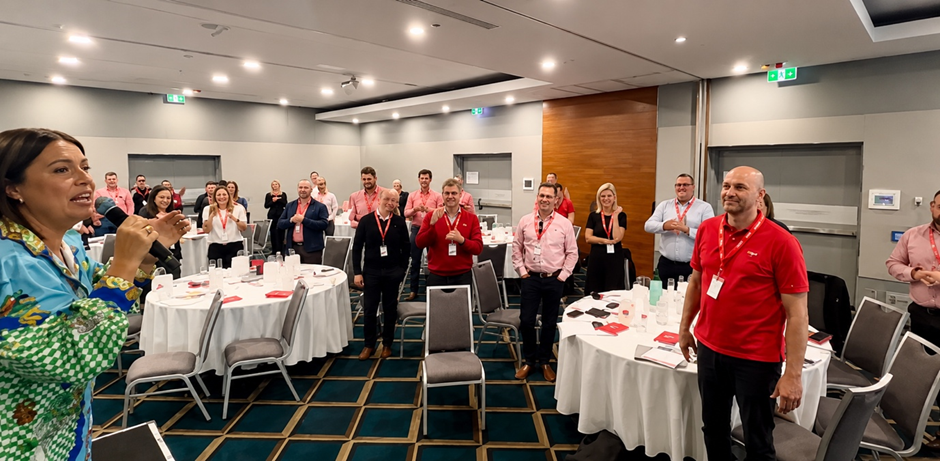
If you’re bringing in an external sales speaker for your conference or kick-off, look for more than an hour of motivation. Seriously, a cricket player or an AI expert can’t help your people sell better!
You’ve probably seen plenty of lists of the top 10 sales motivational speakers. But the best sales motivational speakers don’t just fire up a room. They change what your people do the next morning because they practiced in the room! The best sales speakers understand the psychology of persuasion, the realities of modern business and the conversations your people have every day.
When training budgets are tight, every investment needs to count. Inspiration is wonderful. Improved performance is better.
More sales. Less training. Something has to give.
Businesses can’t always control the economy, customer budgets or competitors. But they can influence how well their people communicate, persuade and perform.
The businesses that succeed won’t necessarily have the biggest sales teams or the most expensive marketing. They’ll be the ones whose people know how to communicate value, build trust and help customers say yes.
In 2027, the ability to persuade isn’t a nice-to-have. It’s a commercial necessity.
Planning your next conference or kick-off? Find out more about Michelle’s sales keynotes.
About Michelle Bowden
Michelle Bowden is a Sydney-based sales keynote speaker and one of Australia’s leading experts in ethical persuasion. For nearly 30 years, she has helped salespeople and leaders communicate value, build trust and win more business. Michelle is the author of How to Present, How to Persuade and How to Connect (Wiley), and the creator of the Persuasion Smart Profile®. Clients such as Google, Salesforce and Woolworths invite her back again and again. Find out more about Michelle’s sales keynotes.

More Stories
How to Teach High Modality Words in Persuasive Writing (Years 3–6)
10 Creative Ways to Supercharge Your Learning with Unconventional Resources
Unlock Your Potential: Top Hidden Gems of Learning Resources You’ve Never Tried